
Genesis shows the steps. EON Universal understands the work.
A composable equipment ontology that turns a green biomedical technician into the equivalent of a multi-year expert recognising devices on sight, composing the correct procedure, and carrying that understanding from the training centre into the field.
Device Classes
Subcomponents · Level 2
Of real work orders
ISO 15225 nomenclature
In hospitals, the senior clinical engineers who hold decades of judgment are retiring as device fleets grow, diversify, and connect. The biomedical equipment technicians replacing them are green, in a domain where being wrong is a patient-safety and escalation problem, not an inconvenience.
Industry has poured money into content: vendor courses tied to one make and model, expensive and of little help on the next device in the queue. Every new model is a new training effort, and the permutations are effectively infinite. The work is treated as an endless list of devices to memorise.
A worker should be able to walk up to a device they have never seen and still do the job correctly.
The worker is green. The guidance is not.
A hospital isn’t a monolith to memorise. Across every ward, biomedical work is performed on a finite library of known device classes the same infusion pumps, ventilators, monitors, defibrillators and analyzers, arranged differently from one site to the next. EON Universal learns the components then composes any device on any ward.
Effort plotted against the number of hospitals you cover.
Enumeration model every site
Composition model the vocabulary
You don’t model every hospital. You model the device classes every hospital is built from.
EON Universal is a facility-agnostic field-intelligence layer for healthcare technology management. It understands medical devices at the level of process intelligence, not merely the steps of a procedure, and uses that understanding to make a green biomed perform like a seasoned clinical engineer.
Names every device on sight and links the real unit to its digital twin. The green worker points; the library identifies.
Composes the correct procedure – conditional SOPs that branch on live conditions, with safety gates that stop the job.
When the library is unsure, it stops and hands off to a human. Judgment is never faked; uncertainty is surfaced.
In a hospital fleet, roughly 50 device classes cover the overwhelming majority of biomedical work. About 15 of them carry most of the daily value – together the core library accounts for more than 80% of real work orders.
The library is built on GMDN / UMDNS (ISO 15225) the medical-device nomenclatures clinical engineers already use. When EON Universal recognises a device, its output maps straight into the hospital’s CMMS / asset register and the device’s service history. It speaks their data language on day one.
Core devices a biomed touches – 80%+ of work orders.
Makes & models – the system is rarely surprised.
Maintainable items: sensors, batteries, valves, boards.
A class name is a label. Understanding is a structure. Explore the six layers EON Universal carries for a single class – here, the device that stores a charge a technician must respect, the defibrillator/monitor.
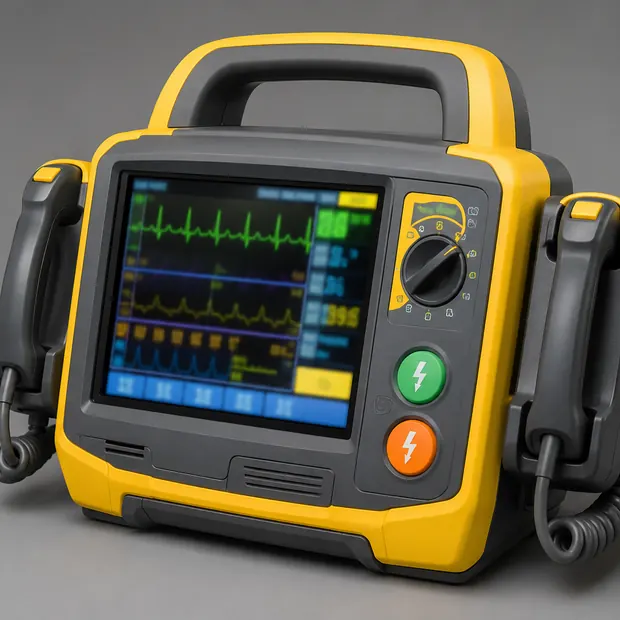
The GMDN/UMDNS class, make and model, and common aliases. This is how the system names what it sees.
Recognition keys on layers 1–2.
Guidance composes from layers 3–6.
The difference between a recording and an understanding.
A 3D GLB twin plus multi-angle imagery, so the device can be recognised and rendered from any viewpoint and matched to the real unit on the bench.
Recognition keys on layers 1–2.
Guidance composes from layers 3–6.
The difference between a recording and an understanding.
Subcomponents and the boundary of the asset: what is part of it, and where it ends.
Recognition keys on layers 1–2.
Guidance composes from layers 3–6.
The difference between a recording and an understanding.
What the device does and its operating envelope – delivers a controlled energy shock to restore a normal rhythm while monitoring ECG, within rated joule and charge-time limits.
Recognition keys on layers 1–2.
Guidance composes from layers 3–6.
The difference between a recording and an understanding.
How it responds to upsets and abnormal conditions. The high-voltage capacitor holds a lethal charge after power-off – it stays dangerous when everything else reads zero; it responds to charge/discharge faults and battery depletion. This is the layer that makes guidance safe.
Recognition keys on layers 1–2.
Guidance composes from layers 3–6.
The difference between a recording and an understanding.
How to operate, inspect, isolate, and fix it – expressed as composable steps rather than a single fixed script.
Recognition keys on layers 1–2.
Guidance composes from layers 3–6.
The difference between a recording and an understanding.
EON Universal does not replace Genesis – EON’s production engine that turns SOPs and ordinary photographs into interactive simulators. Genesis is the on-ramp; Universal is the understanding layer that sits on top. The boundary is exact.
| Genesis - the core engine | EON Universal - intelligence + library |
|---|---|
|
Needs 3D models supplied to it |
Brings the component library and the configurator |
|
Runs sequential SOPs only not conditional |
Authors conditional SOPs that branch on live conditions |
|
Knows what to show, but not why |
Explains why each step matters |
|
Cannot configure different capabilities |
Generalises to skids it has never seen |
|
Does not recognise equipment in real life |
Recognizes equipment on sight feeds Field IQ + Holodeck |
How it’s built
The pyramid – layer by layer. You cannot skip a level.
The lower layers understand components, not hospitals which is exactly the bridge to a universal, facility-agnostic solution.
Use everything in the real field the eventual goal.
Standard service procedures applied on the foundation.
Must-know basics especially safety.
Every component identified and tagged.
An accurate model the base of everything.
A fixed SOP is a straight line. A conditional SOP is a decision tree with safety gates servicing a defibrillator on the bench.
Switch off; isolate from mains.
Disconnect the internal battery.
High-voltage capacitor.
Discharge the high-voltage capacitor through the rated bleed path, then loop back and re-check until safe.
Stored charge released proceed to service the device.
Anything abnormal stops the job and hands off to a human for verification – gated by EON Verdict.
The “capacitor charge still present?” branch only exists because EON Universal knows – from the device’s Behavior layer – that a defibrillator’s high-voltage capacitor holds a lethal charge after power-off. Genesis has no concept of stored charge, so it cannot branch on it. A conditional, safe procedure is something only a system that understands the device can author. The capability isn’t bolted on, it falls out of the understanding.
AR-only practice at 1:1 scale, off-shift, with no device on the bench. Repetition becomes free.
LiDAR overlays the digital twin onto the real device; every part is tappable, guidance anchored to the unit in front of the worker.
LED walls and floor surround the trainee in a generated bay at full scale a modern, reborn iCube. – premium delivery tier
50 classes × 5 images = 250 production images → reconstructed into 50 GLB twins. The recurring primitives, sensors & probes, control boards, displays, pumps & fans, are understood once and inherited by every device that uses them.
Six knowledge layers per object.
4 ortho views + 1 cutaway.
Multiview → GLB mesh.
Drop the GLB into its slot.
The device turns & speaks.
Models, labels, and runs step-by-step SOPs. Capture flows up the stack.
Adds the library, the configurator, and recognition. It understands the work.
Field recognition, on-the-spot guidance, immersive scenarios. Delivery flows back down.
Usage feeds the shared library; the asset improves with operation rather than depreciating.
Recognise, infer topology, compose no per-site rebuild required.
A bounded asset on your balance sheet, not a per-site modelling cost that recurs forever.
General-purpose AI models are a commodity that everyone rents. No foundation model can learn how your hospital runs, because that knowledge has never left your sites. EON Universal turns that proprietary know-how into a structured, owned, compounding asset – the durable advantage as AI absorbs the commoditized work around it.
Because it understands devices rather than memorising hospitals, the same engine transfers to any sector built from a finite parts vocabulary. Healthcare shares the composition logic proven first in oil and gas. Learn the devices once; help every site built from them.
ISO 14224 · 50 classes · 350 subcomponents
~40–60 core classes · same method
High-regulation, high-value part taxonomy
Devices & equipment · same composition logic
A single high-value device family, infusion pumps or ventilators, and a defined set of service procedures, proving the recognise–guide–escalate loop on your own fleet and data.
Class by class along the GMDN/UMDNS vocabulary; delivery expands across phone, tablet-on-the-device, and the CAVE.
Records align with GMDN/UMDNS, so outputs map into existing CMMS and asset-management systems from day one.
Access direct publications and related assets below.